Mobility
Helbiz
Reserve
How might we make sure riders always find a shared scooter nearby, without losing the spontaneity that makes micromobility useful?
Before designing anything, the first step was understanding how workers move around the city.
Cities are looking for greener ways to move, and workers are the ones juggling the tightest schedules between private and working life. The research focused on this group, with a plan built around seven areas: commuting habits, emotions and fears, the strengths and limits of shared micromobility, user needs, room for improvement, their relationship with technology, and their sensitivity to social and environmental values.
The plan combined direct and indirect methods: interviews and a survey with real riders, plus desk and field observation of how the service is described and used.
- 10 one-to-one interviews with commuters.
- Google Form with 84 responses.
- Participants aged 21 to 66.
- 60% employed workers.
- 66.7% women and 33.3% men.
- App Store and Trustpilot reviews.
- Comments under YouTube videos about shared scooters.
- Helbiz scooters observed on the street.
- Rome, Turin and Milan.
Everyone offers a ride. Helbiz also tries to enter the rest of your day, and that is where it gets scattered.
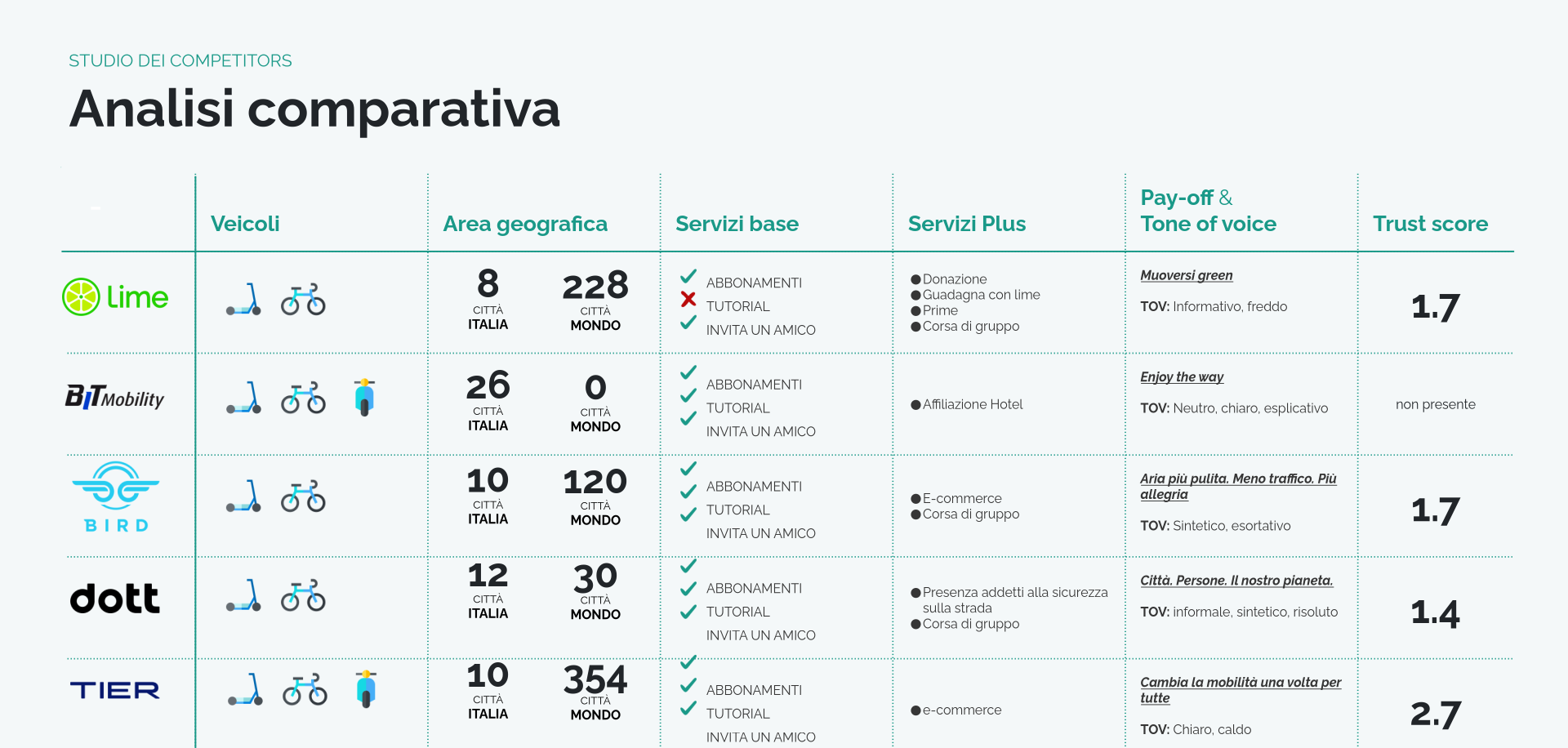
Six providers were compared on vehicles, geographic coverage, base and extra services, pay-off and tone of voice, and trust score. Coverage ranged from 8 to 26 Italian cities. Trust scores were low across the board, between 1.4 and 2.7, which pointed at an open space for a service people can depend on.
Helbiz stood out for its cross-selling approach: extra services such as Wheels, a city guide, sports streaming and food delivery. The flip side is that each service lives in its own app, which creates a sense of dispersion. A review of the Helbiz app itself showed the same issue in the user feedback.
Helbiz app
- A clean, well-designed interface.
- Discounted prices shown directly on the map.
- Battery level visible before booking.
- Directions to walk to the vehicle.
- Three separate apps to access every vehicle type.
- The meaning of the colored map areas is unclear.
- Poor customer support, wrong credits and missing refunds.
- Vehicles are hard to recognize when reserving.
- Unclear subscriptions, such as Unlimited not covering scooters.
Beyond the app, riders described five problems with the service itself.
Interviews, survey and reviews pointed at the same weak spots in the ride experience: vehicles, availability, coverage, riding with others and safety.
Vehicles are often in bad condition.
Scarce availability in the search area.
The service does not cover enough of the city.
Renting for more than one person is difficult.
Especially in traffic.
Interview and survey findings were clustered into eight insights. Four shaped the project.
Together they describe what riders value most: speed, carefree travel, moving as a group and a service that works in every city.
“I don’t want to waste time with the app.”Interviewed rider
Once a vehicle is found, riders want to start in as few taps as possible. A slow flow makes the provider less attractive.
No parking, no ZTL access, no scratches: carefree travel is the main value.
In pairs or groups it is hard to find enough vehicles.
Using the same service in other cities, with no new registration, is a plus.
Three proto personas gave a face to the target.
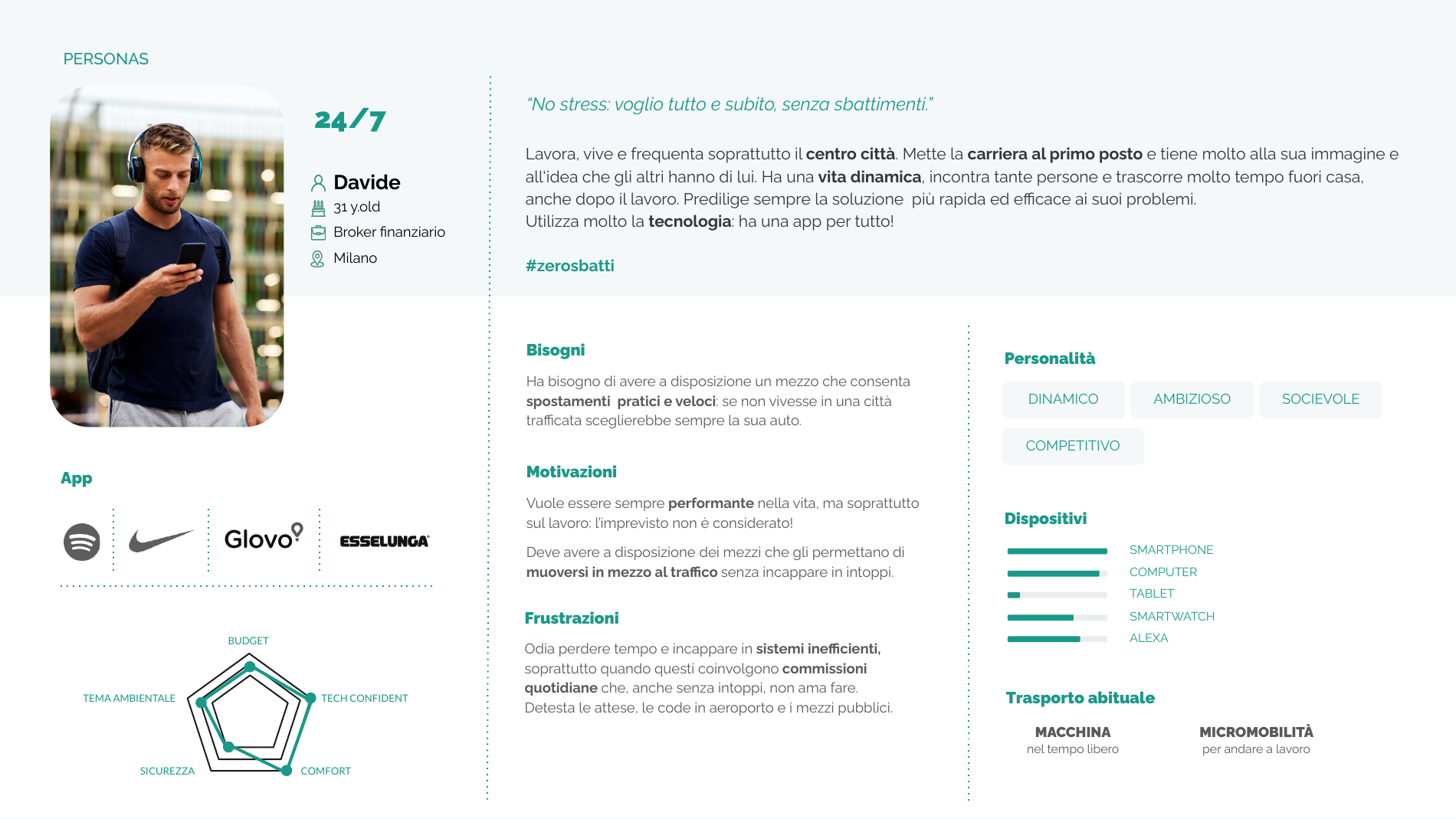
Davide, a 31-year-old financial broker in Milan, wants everything now and hates inefficient systems. Silvia, a 28-year-old music event manager in Rome, needs flexible, safe and sustainable trips on a limited budget. Andrea, a 42-year-old office worker in Turin, loves routine and could not give up his car.
Davide and Silvia guided the design, while Andrea acted as a counterpoint.
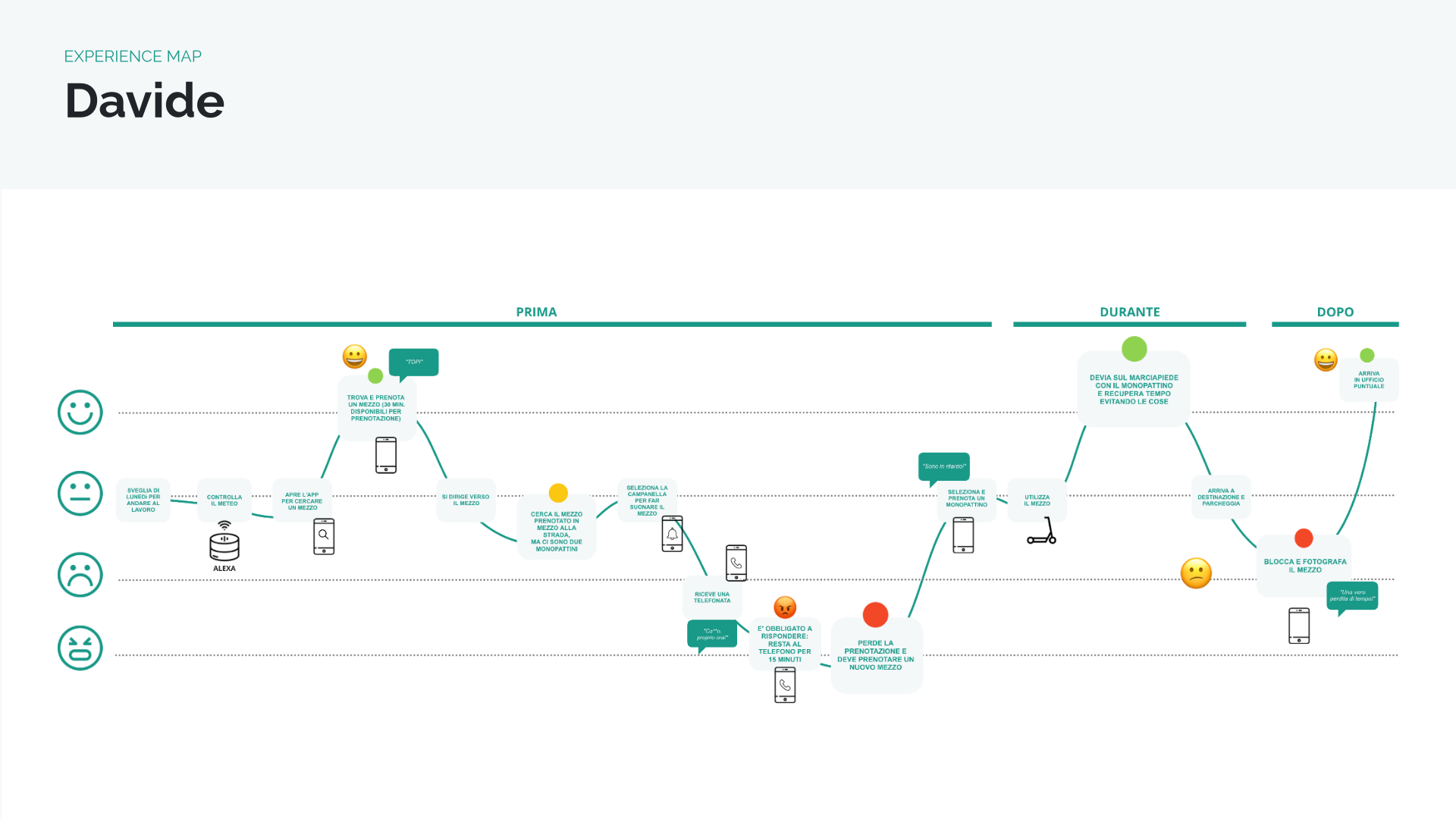
Davide’s day shows where the experience breaks.
Davide’s journey was mapped before, during and after a ride. He reserves a scooter on the map, but a phone call that keeps him busy for 15 minutes makes him lose the booking and forces him to book another vehicle. That is the lowest point of the map, and the moment Reserve is meant to remove.
Once he is riding, the trip works: he recovers time and arrives at the office on time.
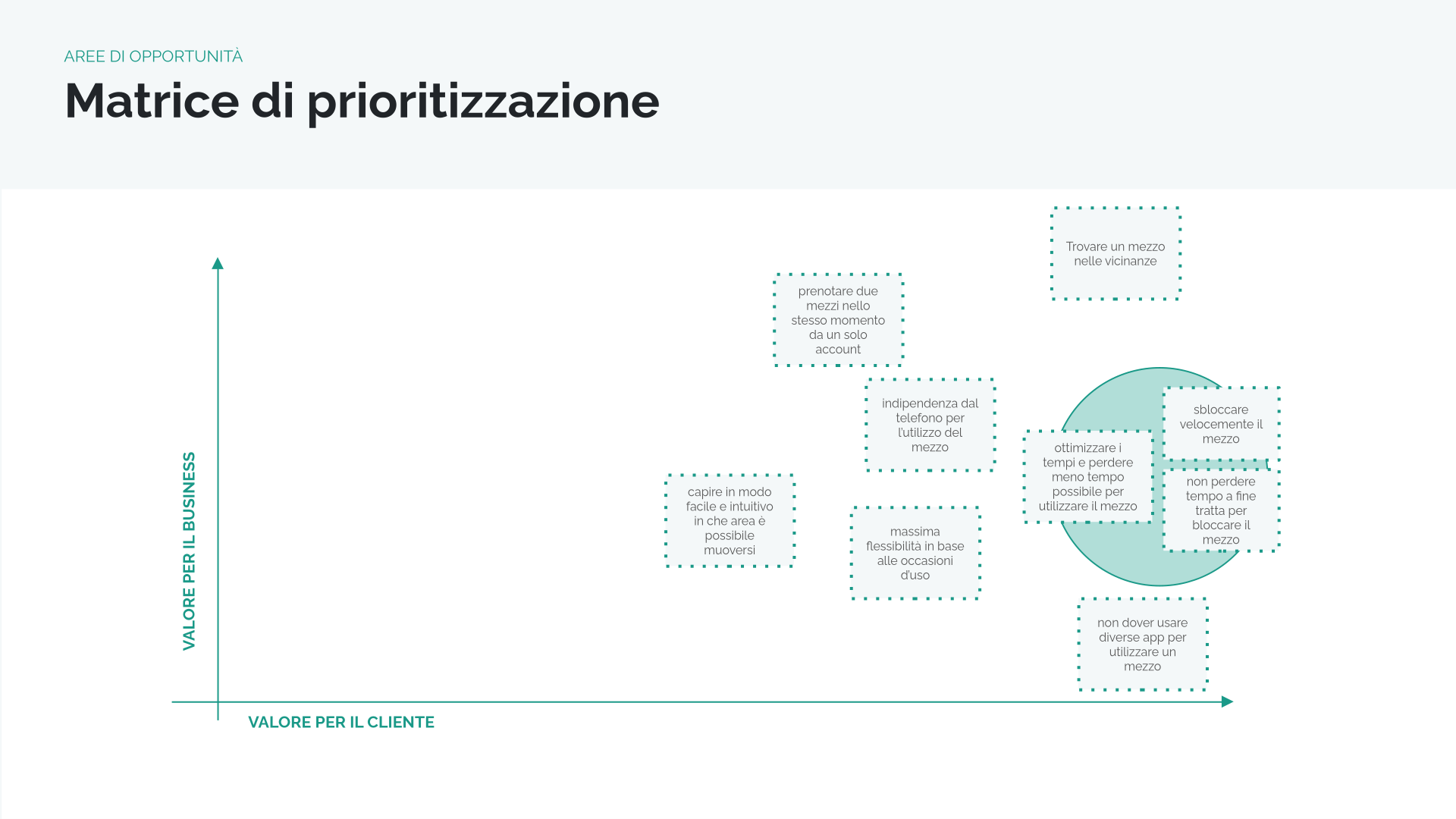
Ideas were mapped by value, voted, and turned into three opportunities.
The ideas were plotted on a prioritization matrix of value for the customer against value for the business. The three opportunities that came out on top became opportunity cards, voted in this order: finding a vehicle nearby, losing as little time as possible to use it, and booking two vehicles at once from a single account.
Each one became a how might we question. This project focuses on the first two.
So that long walks never discourage the rider from using the service.
So that riders reach their destination in the least time.
Book two or more vehicles from the same account, to move together.
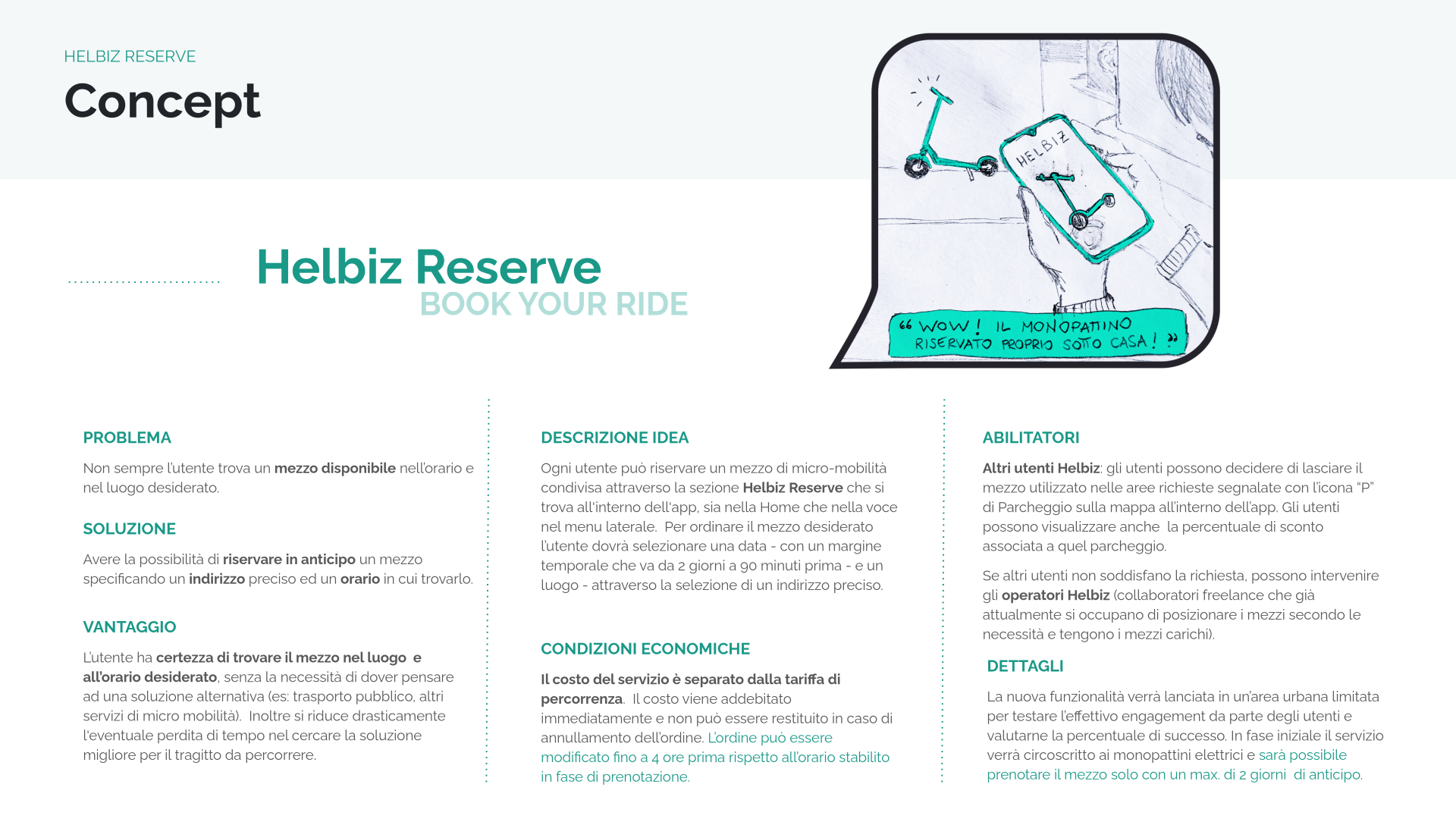
Reserve: order a scooter in advance, for the time and place you need it.
Helbiz Reserve lets riders book a scooter ahead of time at the address and time they choose, so they never have to look for one nearby. Orders can be placed from 2 days down to 90 minutes before the ride and edited up to 4 hours before it. The service has an extra cost, charged immediately and not refunded if the rider cancels.
Two ways in, one short flow.
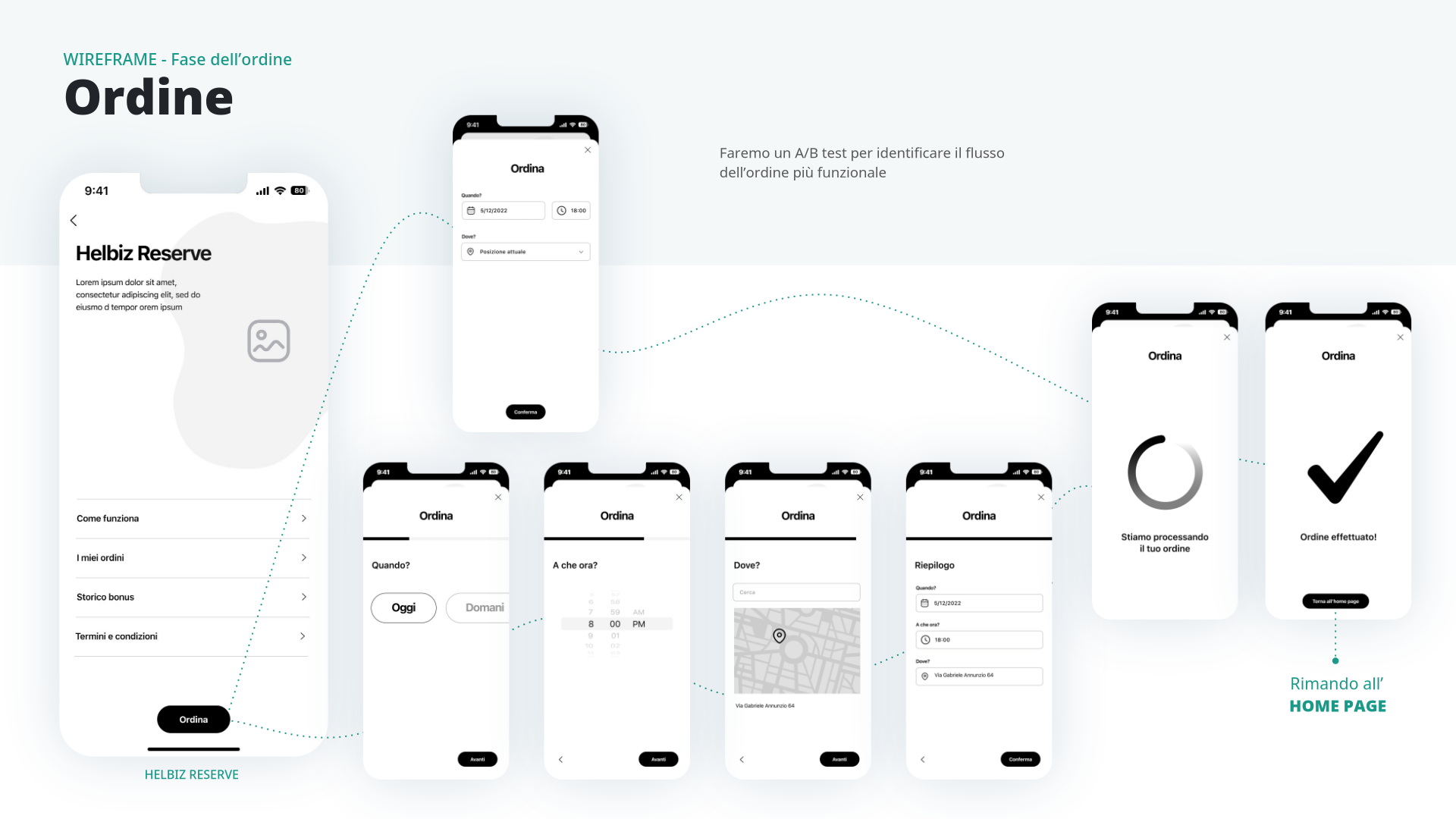
Riders start an order from the scooter map or from the Helbiz Reserve page, which explains the service and collects your orders, the parking bonus, how the service works and its terms.
From there the order takes four steps: when, what time, where, and a summary to confirm. The flow was built as an interactive prototype in Figma, and an A/B test was planned to identify the most effective order flow.
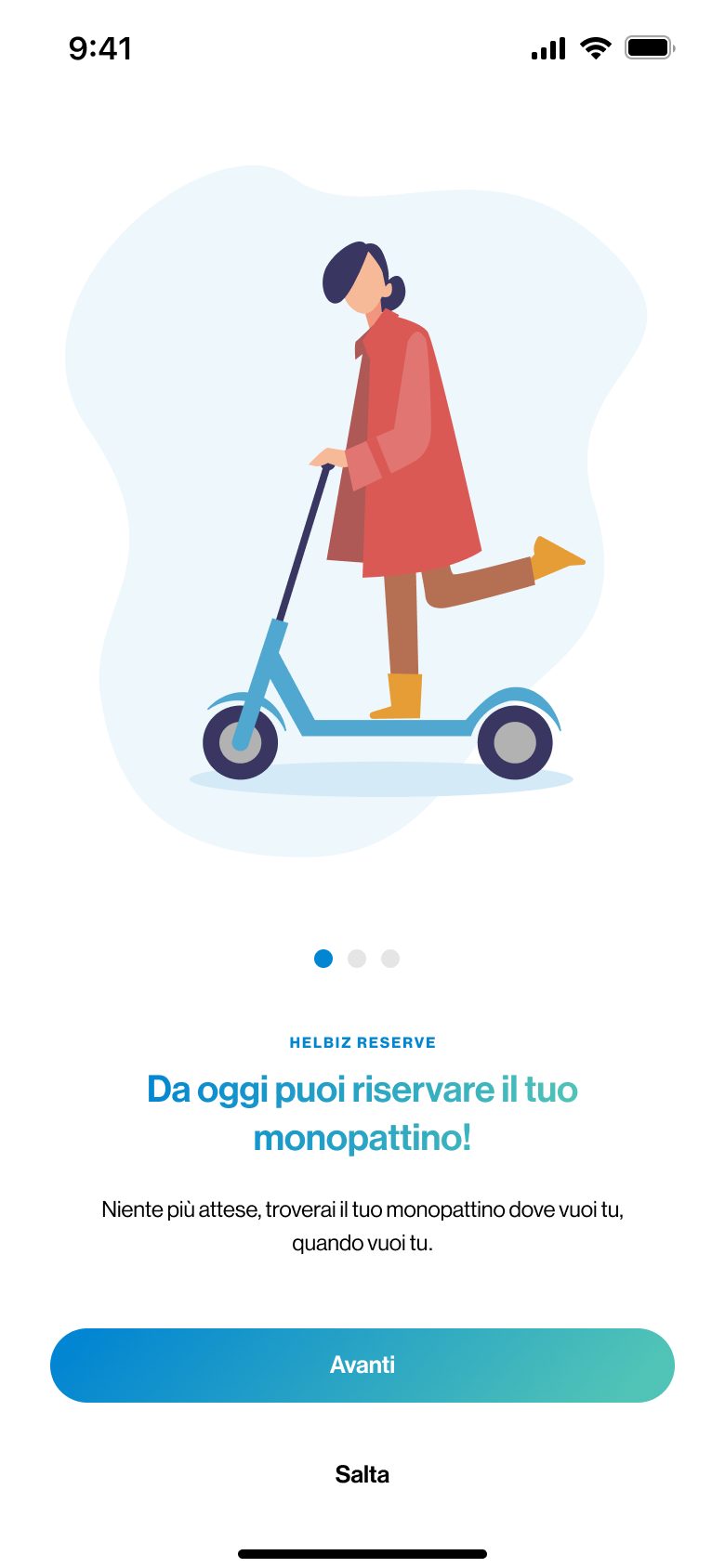
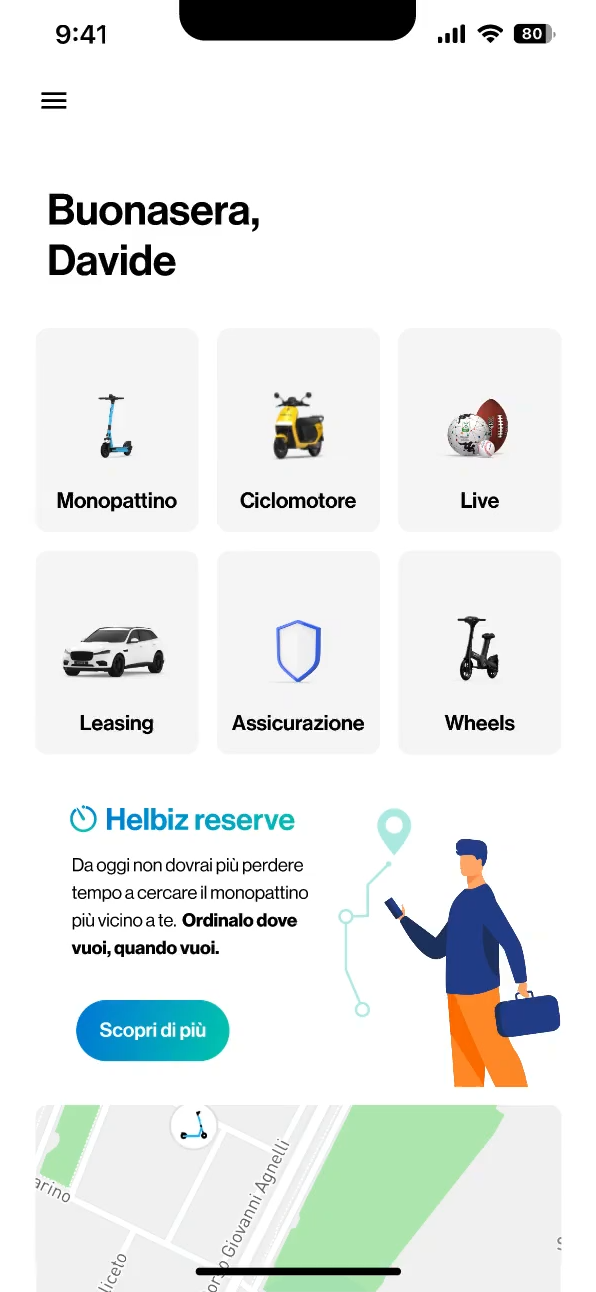
The service is introduced where riders already are.
Entry points are the onboarding, shown at first access or from a push notification, and a promo banner on the home page during the launch period.
Parking bonus
Riders become the ones who make the service work.
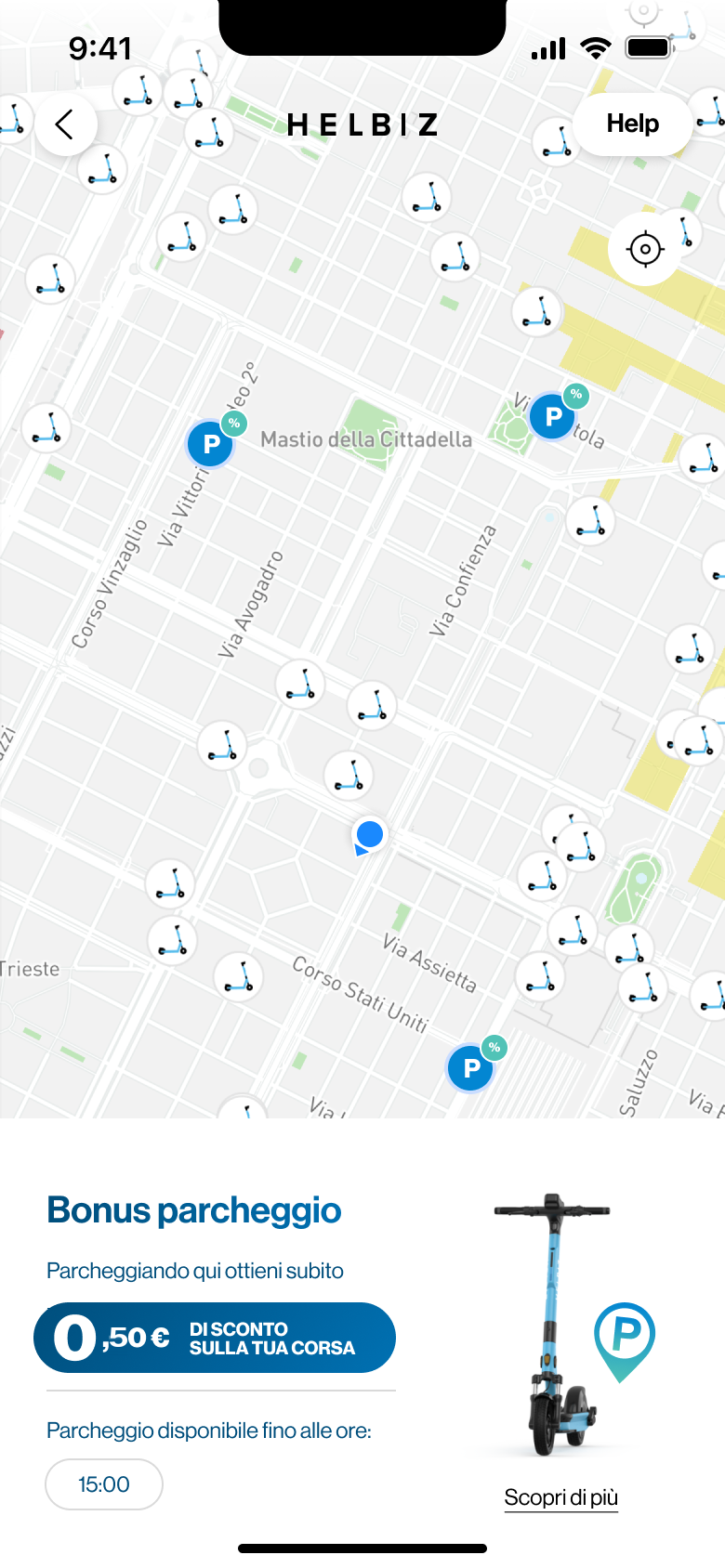
A reserved scooter has to be waiting at the right address. Helbiz users can make that happen: they park a scooter reserved by someone else at the chosen address and get a discount on their ride, the parking bonus.
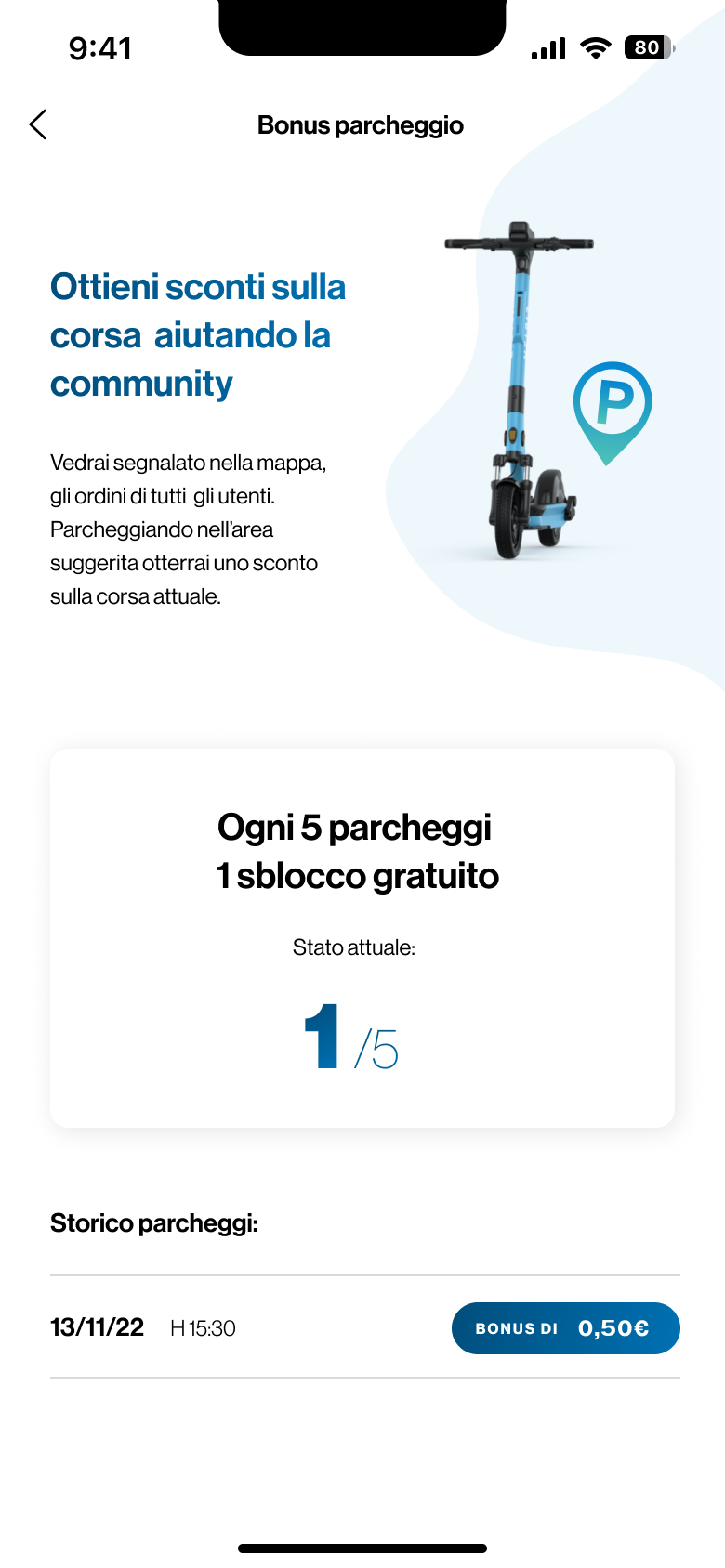
Bonus spots appear on the map with a “P” icon and a preview of the discount. Every five parked scooters unlock a free ride, and a dedicated page tracks progress and history. If that is not enough, Helbiz operators step in.
With Reserve, Helbiz can answer workers who want to embrace micromobility without the frustration of ending up on foot or arriving late. The idea trades a little spontaneity for certainty, so the next step would be validating the price and the booking window with real riders, and testing how the parking bonus works when scooters are scarce.